Solar PV Troubleshooting Technician Course
The Solar PV Troubleshooting Technician Course is designed to develop specialized skills in identifying and resolving faults in solar photovoltaic systems. It covers systematic troubleshooting methods for panels, inverters, wiring, protection devices, and monitoring systems, along with electrical safety practices. Through hands-on diagnostics and real-world fault scenarios, learners gain practical experience in minimizing downtime and restoring system performance. This course prepares participants for technical roles focused on ensuring the reliability and efficiency of solar PV installations.
- 36 Hours (2 hours/day x 6 days/week x 70 weeks) OR at your own pace
- Hindi, English
- Learn & Get Certified
- Basic & Intermediate
- Hands-On Training

Online Course Fees
Offline Course Fees
About this course
The Solar PV Troubleshooting Technician Course is a 36-hour practical training program.
It is designed to prepare learners to diagnose, analyze, and resolve electrical, mechanical, and performance-related issues in solar photovoltaic (PV) systems. The course emphasizes fault detection techniques, systematic troubleshooting approaches, and the use of diagnostic tools commonly applied across residential, commercial, and small industrial solar installations.
Through structured modules, participants learn:
– Overview of solar PV components and system operation
– Types of faults in PV systems (open circuits, short circuits, ground faults, hotspot formation, inverter errors)
– Step-by-step troubleshooting workflows for DC and AC sides
– Use of diagnostic tools: multimeter, clamp meter, insulation tester, thermal camera, IV curve tracer
– String-level and module-level fault identification
– Inverter fault codes, grid issues, and communication errors
– Detection of shading, mismatch, cable faults, and degradation
– Corrective actions, repair techniques, and best practices
– Safety guidelines, LOTO procedures, and reporting standards
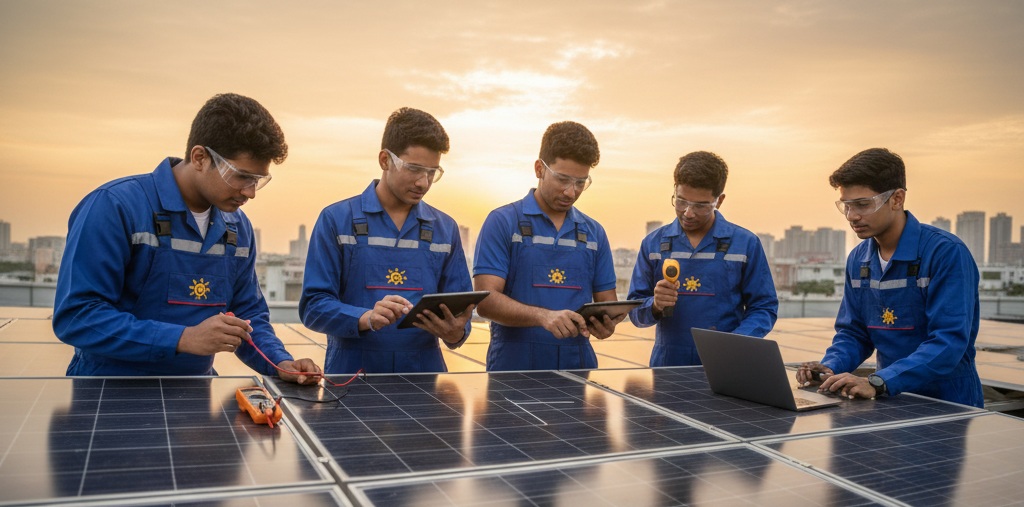
Hands-on practice includes real-time fault simulation, checking voltage/current mismatches, identifying loose connections, interpreting inverter alarms, measuring insulation resistance, and verifying system restoration after corrective actions.
By the end of the program, participants are prepared to:
– troubleshoot common and complex issues in solar PV systems,
– perform systematic diagnostics using industry-standard test equipment, and
– work as Solar PV Troubleshooting Technicians, Field Support Technicians, or O&M Specialists in solar maintenance and service teams.
This course provides essential knowledge and practical training to build industry-relevant skills.
- Online Course Fees: ₹3500, ₹2000 (incl. GST) (Excluding tools & equipment cost)
- Offline Course Fees: ₹8500, ₹6000 (incl. GST) (Excluding tools & equipment cost)
- Certification: TCoE
- Duration: 36 Hours (2 hours/day x 6 days/week x 70 weeks) OR at your own pace
What you'll learn
After this course you will learn:
- In-Depth Understanding of Solar PV Components: Learn the working principles of modules, inverters, junction boxes, protection devices, cabling, and monitoring systems.
- Advanced Fault Identification Techniques: Master methods to detect issues such as string mismatch, shading losses, module degradation, loose terminations, and earthing faults.
- Diagnostic Testing & Measurement Skills: Use tools like multimeters, clamp meters, insulation testers, IV curve tracers, and thermal cameras for accurate fault diagnosis.
- Inverter Fault Code Analysis & Remedies: Understand common inverter errors, DC/AC side failures, grid-related faults, and appropriate troubleshooting procedures.
- DC & AC Side Troubleshooting Procedures: Learn to systematically inspect strings, arrays, DC combiner boxes, AC distribution panels, and power line connectivity.
- Performance Deviation Analysis: Identify low-generation issues by analyzing PR (Performance Ratio), energy yield trends, and string-wise performance data.
- Repair & Component Replacement Skills: Gain practical experience in fixing wiring faults, replacing fuses/MC4 connectors, repairing loose joints, and handling balance-of-system components.
- Safety Protocols for High-Risk Troubleshooting: Learn advanced PPE usage, arc-flash safety, LOTO procedures, rooftop/rack safety, and safe handling of energized equipment.
Course Content
Why take this course?
This course focuses on developing specialized skills to quickly identify and resolve faults in solar photovoltaic systems. You will learn systematic troubleshooting techniques for panels, inverters, wiring, protection devices, and monitoring systems, along with safety and diagnostic best practices. As solar installations grow in size and complexity, efficient troubleshooting is critical to reduce energy losses and downtime. This course prepares you for high-demand technical roles, enabling you to ensure reliable system performance and support the efficient operation of solar power plants.
How to use online TCoE platform?
- History and use cases of drones.
- Types of Drones, Drone Sizes.
- DGCA rules and regulations.
- Flying Zones, Pilot licensing.
- Job Opportunities and Businesses in Drones, Drone Manufacturers
Tools and Equipment required
National Skill Development Mission
Drone Frame and Components
- Frame Design, Frame types, Material selection, Custom fabrication.
- Motors, ESCs, props.
- GPS, Pixhawk FC, RC setup.
- Spray tank integration.
- Power systems and battery safety.
Manual Flight Practice & Safety
- Simulation Flying, Hovering.
- Pattern flying.
- Line-of-sight control.
- Emergency handling, Safety Practices.
Drone Assembly
Drone Assembly, drone inspection, Maintenance, Pump and nozzle setup and spray control
Project
Build a fully functional basic drone
ENROLL TODAY & GET 30% OFF ON ALL COURSES
Your Future Can’t Wait, Enroll Now and Save 30% On All Courses.
Related Courses
Solar PV Monitoring Technician

Solar PV Maintenance Technician

Solar PV Troubleshooting Technician
Solar PV Engineer
See what our students have to say
With over a decade of experience, our mission is to produce future-ready skilled resources.
Grid Integration and Power Management
This topic explores how solar powerplants are connected to the electrical grid and how energy flow is controlled to maintain stability and efficiency. Learners will understand grid synchronization, power quality management, and smart inverter technologies that help balance supply and demand. By mastering this concept, students gain insight into how large-scale solar energy systems contribute to reliable and sustainable electricity distribution.
Job Opportunities
Here are some interesting job opportunities after completing the Solar Power Plants course:
Solar Powerplant Engineer
Design, operate, and maintain large-scale solar installations, ensuring optimal performance and reliability.Grid Integration Specialist
Manage the connection of solar powerplants to the electrical grid, focusing on power stability and quality control.Grid Integration Specialist
Manage the connection of solar powerplants to the electrical grid, focusing on power stability and quality control.Performance Monitoring Analyst
Analyze energy output data, detect inefficiencies, and implement optimization strategies for solar plants.Operations & Maintenance (O&M) Engineer
Conduct regular inspections, preventive maintenance, and troubleshooting to maximize plant efficiency.Renewable Energy Consultant
Advise companies and governments on solar project feasibility, design improvements, and sustainability strategies.Solar Plant Supervisor
Supervise daily plant operations, manage field technicians, and ensure adherence to safety and quality standards.- Technical Trainer – Solar Powerplants
Train technicians and engineers in installation, operation, and maintenance best practices for large-scale solar facilities.
Frequently asked questions
What is the main focus of this course?
The course focuses on understanding, designing, operating, and maintaining large-scale solar powerplants for efficient and reliable energy generation.
Do I need prior experience in solar energy to enroll?
No prior experience is required. Basic knowledge of electricity or renewable energy concepts can be helpful but isn’t mandatory.
Will the course cover practical applications?
Yes, the course includes real-world examples, case studies, and demonstrations of installation, monitoring, and maintenance of solar powerplants.
What career opportunities are available after this course?
Graduates can work as Solar Powerplant Engineers, O&M Engineers, Grid Integration Specialists, Project Managers, or Performance Analysts in the renewable energy sector.
How does this course help in promoting sustainability?
It equips learners with the skills to design and operate efficient solar powerplants, contributing to clean energy production and reducing reliance on fossil fuels.
Is this course suitable for working professionals?
Absolutely! Professionals in electrical, mechanical, or renewable energy fields can enhance their expertise and open new career avenues in solar energy.