
Agricultural Drone Engineer
The Agricultural Drone Engineer Course is designed to train learners in the application of drone technology for modern and precision agriculture. It covers drone platforms, sensors, spraying and imaging payloads, flight planning, data collection, and basic analysis for crop monitoring and farm management. Through hands-on training and real-world use cases, learners gain practical skills to improve productivity, reduce resource usage, and support sustainable farming practices. This course prepares participants for technical and operational roles in the rapidly growing agri-drone and smart agriculture sector.
- 72 Hours (2 Weeks Full-Time)
- Hindi, English
- Learn & Get Certified
- Basic & Intermediate
- Hands-On Training
Online Course Fees
Offline Course Fees
About this course
Agricultural Drone Engineer Course is a specialized, application-focused course designed to train professionals in the design, operation, and deployment of drones for modern precision agriculture. The course covers agricultural drone systems, spraying and seeding mechanisms, payload integration, flight planning, crop monitoring, multispectral data acquisition, maintenance, and safety practices. Learners gain practical skills in optimizing drone performance for farming operations, ensuring regulatory compliance, and improving crop productivity and resource efficiency. This course prepares candidates for roles in agri-tech companies, drone service providers, cooperatives, and smart farming initiatives, supporting sustainable and technology-driven agriculture.
This course provides essential knowledge and practical training to build industry-relevant skills.
Fees: ₹10,000, ₹8,000 (incl. GST)
Certification: TCoE
Duration: 72 hours (2 hours/day x 6 days/week x 6 weeks) OR at your own pace
What you'll learn
After this course you will learn:
- Agriculture-Specific Drone Fundamentals – Understand multi-rotor and fixed-wing drones used in Indian farming for spraying, mapping, and crop monitoring.
- Payload & Spraying System Integration – Learn installation, calibration, and maintenance of pesticide/fertilizer tanks, pumps, nozzles, and flow-rate control systems.
- Crop Mapping & Data Acquisition – Use RGB and multispectral sensors for crop health analysis, NDVI mapping, yield estimation, and farmland surveying.
- Indian FARMLAND Use– Design drones for paddy, sugarcane, cotton, wheat, and horticulture applications considering Indian climate and terrain.
- DGCA Compliance for Agri-Drones – Learn type certification norms, UIN registration, green-zone operations, and RPL requirements for agricultural drone missions.
- Battery, Power & Heavy-Lift Management – Handle high-capacity LiPo/Li-ion batteries, optimize flight time under heavy payloads, and troubleshoot power drops.
- Field Maintenance & Troubleshooting – Diagnose common issues like motor overheating, pump failures, clogging, sensor drift, and sprayer leakage during field operations.
- Safe Application & Farmer Workflow Integration – Learn safe chemical handling, drift reduction techniques, flight planning for farms, and integration with FPOs, agri-startups, and government schemes.
Course Content
Why take this course?
This course prepares you to apply drone technology to modernize and optimize agricultural practices. You will learn how to design, operate, and manage drones for crop monitoring, precision spraying, soil analysis, and yield assessment, along with understanding sensors, payloads, and data interpretation. As precision agriculture gains momentum, skilled agricultural drone engineers are in high demand to improve productivity, reduce costs, and promote sustainable farming. This course equips you with industry-relevant, practical skills to build a rewarding career at the intersection of agriculture, technology, and smart farming solutions.
How to use online TCoE platform?
Tools and Equipment required
National Skill Development Mission
Module-1: Introduction to Drones
This module introduces learners to the world of drones, covering the basics of unmanned aerial vehicles (UAVs). Students will explore drone types, components, and applications across industries such as agriculture, logistics, surveillance, and recreation. The module also highlights essential terminology, safety guidelines, and regulations. By the end of this module, learners will have a foundational understanding of drones, preparing them for assembly, operation, and maintenance in subsequent modules.
Module-2: Regulatory Framework
This module introduces learners to the legal and regulatory requirements for operating drones safely and responsibly. It covers national and international drone laws, licensing requirements, airspace restrictions, privacy considerations, and safety standards. Students will also learn about compliance procedures and documentation necessary for lawful drone operations. By the end of this module, learners will understand the regulatory framework governing drones, ensuring safe, legal, and responsible flying practices.
Module-3: Components
This module familiarizes learners with the essential components of a drone and their functions. It covers the frame, motors, propellers, flight controllers, batteries, sensors, and communication systems. Students will also learn how each component contributes to flight, stability, and control. By the end of this module, learners will have a clear understanding of drone hardware, preparing them for assembly, calibration, and maintenance tasks in later modules.
Module-4: Flight Dynamics
This module introduces the principles of drone flight and the forces that govern it. Learners will explore key concepts such as lift, thrust, drag, and weight, as well as stability, control, and maneuvering. The module also covers flight modes, navigation basics, and how sensors like gyroscopes and accelerometers help maintain balance and orientation. By the end of this module, students will understand how drones fly and respond to controls, laying the foundation for practical flying and troubleshooting.
Module-5: Operating a drone using a simulator
This module teaches learners how to operate drones safely using simulation software. Students will practice take-off, landing, hovering, and basic maneuvers in a virtual environment, reducing risks associated with real-world flights. The module also introduces different flight modes, mission planning, and emergency handling. By the end of this module, learners will gain confidence and essential piloting skills, preparing them for actual drone operation.
How to use online TCoE platform?
Advantages of this course
Tools and Equipment required
National Skill Development Mission
ENROLL TODAY & GET 30% OFF ON ALL COURSES
Your Future Can’t Wait, Enroll Now and Save 30% On All Courses.
Related Courses
Terrain Mapping Drone

Drone Engineer
Junior Engineer Drone (R & D)

UAV Regulatory Affairs Consultant
See what our students have to say
With over a decade of experience, our mission is to produce future-ready skilled resources.

B. Tech., IIT-Kharagpur
Precision Agriculture with Drones
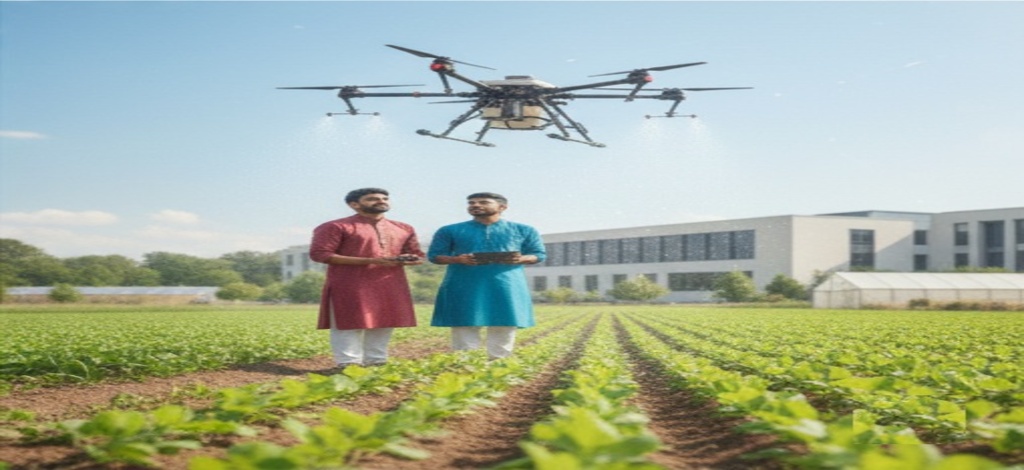
This module focuses on using drones to enhance farming efficiency and crop management. Learners explore techniques such as aerial imaging, crop health monitoring, soil analysis, and automated spraying. By analyzing real-time data collected by drones, students can make informed decisions to optimize irrigation, fertilization, and pest control. Mastery of this topic equips learners to apply drone technology to increase agricultural productivity, reduce resource wastage, and support sustainable farming practices.
Job Opportunities
Here are some interesting job opportunities after completing the Agricultural Drone course:
Precision Agriculture Specialist – Use drones to monitor crop health, optimize irrigation, and improve yields.
Agricultural Drone Operator – Conduct aerial surveys, map fields, and collect data for farms and agribusinesses.
Drone Data Analyst (Agriculture) – Analyze drone-collected data for soil health, crop stress, and pest management.
Agri-Tech Drone Consultant – Advise farmers and companies on implementing drone technology for efficient farming.
Drone Maintenance & Service Technician – Maintain and repair agricultural drones to ensure smooth operation.
Crop Monitoring & Research Assistant – Support agricultural research projects using drone-based monitoring tools.
Frequently asked questions
Do I need prior experience with drones or farming?
No prior experience is required. The course covers both drone basics and agricultural applications, making it suitable for beginners and professionals alike.
Will there be hands-on training?
Yes! You’ll get practical experience flying agricultural drones, collecting data, and analyzing crop health to make actionable decisions.
What industries can I work in after completing this course?
Graduates can work in agriculture, agritech companies, farm management, research organizations, and drone service providers.
What makes this course different from general drone courses?
Unlike general drone courses, this program focuses specifically on agriculture applications, teaching you how to leverage drones to increase efficiency, reduce costs, and boost crop yields.