
Drone Service Technician Course
The Drone Service Technician Course is a practical, skill-focused program designed to train learners in servicing, troubleshooting, and supporting drone operations. It covers drone components, routine servicing, fault diagnosis, repairs, calibration, and operational safety. Through hands-on training, learners gain real-world experience in maintaining flight-ready drones and minimizing downtime. This course prepares participants for technical support roles in drone service centers, fleet operations, and drone-based industry applications.
- 450 Hours (2 hours/day x 6 days/week x 38 weeks) OR at your own pace
- Hindi, English
- Learn & Get Certified
- Basic & Intermediate
- Hands-On Training


Online Course Fees
Offline Course Fees
About this course
The Drone Service Technician (ELE/Q7003, NSQF Level-4) Course equips learners with skills to maintain, troubleshoot, calibrate, and repair drones of various types used in fields such as aerial photography, inspections, emergency operations, and goods transport. Over approximately 450 hours of training—mixing theory, practical lab work, and on-job training—the course covers modules like routine repair and maintenance, performance testing and calibration, employability skills, and safety practices. The aim is to develop technicians who can work in service & repair centres, support after-sales operations, or even start their own drone servicing ventures.
This course provides essential knowledge and practical training to build industry-relevant skills.
- Online Course Fees: ₹3500, ₹2000 (incl. GST) (Excluding tools & equipment cost)
- Offline Course Fees: ₹14000, ₹12500 (incl. GST) (Excluding tools & equipment cost)
- Certification: ESSCI
- Duration: 450 Hours (2 hours/day x 6 days/week x 38 weeks) OR at your own pace
What you'll learn
After this course you will learn:
- Drone Components & Systems: Understand the structure, function, and integration of major drone parts including motors, ESCs, flight controllers, and sensors.
- Maintenance Procedures: Learn step-by-step preventive maintenance practices to enhance drone reliability and lifespan.
- Troubleshooting Techniques: Develop the ability to identify, diagnose, and fix common hardware and software issues.
- Battery & Power Management: Gain knowledge on safe battery handling, charging, and power system optimization.
- Repair & Replacement Skills: Practice disassembling, repairing, and reassembling drone components with precision.
- Calibration & Testing: Learn to calibrate sensors, test flight stability, and ensure performance accuracy.
- Safety & Compliance: Understand maintenance safety protocols and follow standard industry guidelines.
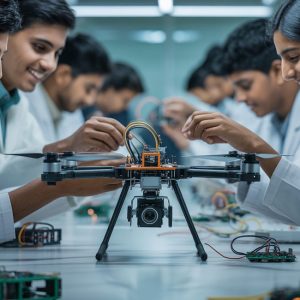
- Hands-on Practice: Perform real-time servicing tasks on different drone models to build technical confidence.
Course Content
Why take this course?
This course trains you to provide comprehensive technical support for drones, including assembly, maintenance, troubleshooting, and operational readiness. You will gain hands-on experience with drone components, sensors, controllers, batteries, and payload systems, along with practical skills to diagnose and resolve common issues. As drones see growing use in agriculture, surveying, logistics, media, and industrial inspections, skilled service technicians are essential for ensuring safe, efficient, and uninterrupted operations. This course prepares you for a hands-on, in-demand career in the fast-expanding drone services industry.
How to use online TCoE platform?
Tools and Equipment required
National Skill Development Mission
Module-1: Routine repair and maintenance of a Drone
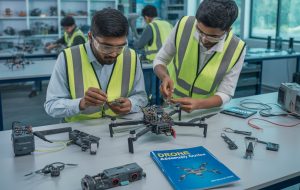
• Demonstrate the process of assembling/ disassembling a Drone.
• Demonstrate the process of inspecting the functional components of a Drone for defects.
• Demonstrate the process of repairing/ replacing the defective components of a Drone.
• Demonstrate the process of testing the functioning of a Drone after repair and maintenance.
Module-2: Calibrate, Optimize and Test Drone Performance
- Demonstrate proficiency in calibrating and optimizing drone components for accurate and efficient performance.
- Perform advanced testing and troubleshooting to ensure safety, compliance, and operational reliability.
- Maintain comprehensive documentation and effectively communicate outcomes to stakeholders.
Module-3: Employability Skills
- Discuss about Employability Skills in meeting the job requirements.
- Describe opportunities as an entrepreneur.
- Describe ways of preparing for apprenticeship & Jobs appropriately.
Module-4: On-the-Job Training
- Explain the fundamental concept of a Drone
- Illustrate the preliminary tasks involve in the repair and maintenance of a Drone
- Demonstrate how to perform preliminary checks on a Drone
- Demonstrate how to carry out troubleshooting for different issues in a Drone
- Inspect the Drone to spot defective module/ components
- Demonstrate repair/ replacement of electronic components
- Test functioning of the Drone post servicing
- Communicate product and service-related information to the customer
- Interact and coordinate with supervisor and colleagues
- Perform assigned work within timelines and with defined quality
- Demonstrate how to maintain a healthy, safe and secure working environment
ENROLL TODAY & GET 30% OFF ON ALL COURSES
Your Future Can’t Wait, Enroll Now and Save 30% On All Courses.
Related Courses

Drone Assembly Technician

Drone Maint. & Repair Technician: Level-1

Drone Maint. & Repair Technician: Level-2

Drone Engineer
See what our students have to say
With over a decade of experience, our mission is to produce future-ready skilled resources.
Drone Troubleshooting and Diagnostics
This module focuses on identifying and resolving technical issues that affect drone performance. Learners will explore systematic diagnostic procedures to detect problems in motors, flight controllers, GPS modules, sensors, and communication systems. The topic covers both software and hardware troubleshooting using specialized tools and simulation techniques. By mastering this area, students gain the ability to efficiently pinpoint faults, perform accurate repairs, and restore drones to optimal flight condition — a critical skill for any professional drone service technician.
Job Opportunities
Here are some interesting job opportunities after completing the Drone Service Technician course:
Drone Maintenance Technician – Perform regular inspections, maintenance, and repairs to ensure drones operate safely and efficiently.
Drone Repair Specialist – Diagnose and fix hardware or software malfunctions in drones used for commercial, industrial, or recreational purposes.
Field Service Engineer (Drones) – Provide on-site technical support and servicing for drones used in sectors like agriculture, construction, and surveillance.
Drone Assembly Technician – Work with manufacturing teams to assemble and test drones before delivery to clients.
Technical Support Executive (Drone Companies) – Offer remote or in-person assistance to customers facing technical issues with their drones.
Drone Calibration Expert – Specialize in sensor alignment, flight control tuning, and performance optimization.
Workshop Technician (Drone Service Centers) – Operate in maintenance hubs handling drone servicing, upgrades, and part replacements.
- Entrepreneur / Drone Service Provider – Start your own drone maintenance and repair business catering to industries like media, logistics, and agriculture.
Frequently asked questions
Do I need any prior experience to join this course?
While self-learning can provide a baseline understanding, structured drone courses ensure compliance with aviation regulations, standardized flight procedures, and industry safety protocols. Professional instruction covers legal frameworks, advanced operational techniques, and real-world scenarios that online tutorials often overlook. This reduces the risk of fines, accidents, or inefficient workflows.
Will I get practical training in this course?
Most providers supply training drones for coursework. However, pilots are encouraged to invest in professional UAVs aligned with their career goals (e.g., DJI Mavic 3E for surveying, DJI Inspire for cinematography, or heavy-lift drones for LiDAR). Ground control software, GPS mapping tools, and data processing platforms (Pix4D, DroneDeploy) are also often introduced.
What kind of tools or equipment will I learn to use?
Yes. Reputable training providers emphasize operational liability, mandatory insurance coverage, and contractual obligations. This ensures that pilots understand both the legal and financial protections necessary for commercial operations.
Will I receive a certificate after completion?
Yes, upon successfully completing all modules and assessments, you’ll receive a course completion certificate recognized in the drone industry.
How is this course different from other drone-related programs?
While most drone courses focus on flying or photography, this one emphasizes technical expertise — helping you master the engineering side of drone servicing and repair.