3D Printing Designer: Level-2 Course
3D Printing Designer: Level-2 is an advanced-level course designed to deepen expertise in high-end design and manufacturing using additive technologies. The course focuses on advanced CAD modeling, design for additive manufacturing (DfAM), material optimization, process control, and production-quality printing. With strong hands-on training, learners develop the ability to create complex, functional, and industry-ready components. This course prepares professionals to apply 3-D printing for advanced prototyping, product development, and specialized manufacturing across high-growth industries.
- 144 Hours (2 hours/day x 6 days/week x 6 weeks) OR at your own pace
- Hindi, English
- Learn & Get Certified
- Basic & Intermediate
- Hands-On Training
Online Course Fees
Offline Course Fees
About this course
3D Printing Designer: Level-2 Course is a professional, skill-intensive course focused on advanced design, optimization, and production using additive manufacturing technologies. The course covers complex CAD modeling, design for additive manufacturing (DfAM), material selection, advanced slicing strategies, process optimization, quality control, and post-processing techniques. Learners gain hands-on experience in designing functional and production-ready components, improving strength, accuracy, and efficiency of prints. This course prepares candidates for advanced roles in product design, rapid prototyping, tooling, and additive manufacturing applications across industries such as aerospace, automotive, healthcare, and industrial manufacturing.
- Online Course Fees: ₹3500, ₹2500 (incl. GST) (Excluding tools & equipment cost)
- Offline Course Fees: ₹25000, ₹22000 (incl. GST) (Excluding tools & equipment cost)
- Certification: TCoE
- Duration: 144 Hours (2 hours/day x 6 days/week x 6 weeks) OR at your own pace
What you'll learn
After this course you will be able to:
- Advanced 3D Modeling Techniques: Master complex geometries, organic shapes, parametric design, and intricate features using professional CAD tools.
- Topology Optimization: Learn how to reduce weight, improve strength, and enhance performance through smart structural optimization algorithms.
- Design for Additive Manufacturing (DfAM): Understand how to design parts specifically for 3D printing, considering orientation, support structures, and printability.
- Simulation & Analysis: Perform stress, thermal, and motion simulations to validate and refine your designs before printing.
- Multi-Material & High-Precision Printing: Explore advanced printing methods involving resin, flexible materials, composites, and metal-like filaments.
- Industrial 3D Printing Workflows: Gain practical experience in slicing, preparing, and optimizing files for professional-grade 3D printers.
- Surface Detailing & Complex Texturing: Create detailed patterns, lattices, textures, and organic structures for both functional and aesthetic applications.
- Post-Processing & Finishing Techniques: Learn advanced methods like curing, polishing, assembling, vapor smoothing, and painting for a professional finish.
Course Content
Why take this course?
This advanced course is designed for learners who want to master complex design and optimization techniques for additive manufacturing. You will learn advanced CAD modeling, design for additive manufacturing (DfAM), material selection, process optimization, and post-processing methods. With industries increasingly adopting 3D printing for functional parts and customized products, skilled designers are in high demand. This course equips you with industry-level expertise to create high-performance, manufacturable designs and pursue advanced roles in product development, prototyping, and digital manufacturing.
How to use online TCoE platform?
Lorem ipsum dolor sit amet, consectetur adipiscing elit. Ut elit tellus, luctus nec ullamcorper mattis, pulvinar dapibus leo.
Tools and Equipment required
National Skill Development Mission
ENROLL TODAY & GET 30% OFF ON ALL COURSES
Your Future Can’t Wait, Enroll Now and Save 30% On All Courses.
Related Course
3D Printing Designer: Level-1
See what our students have to say
With over a decade of experience, our mission is to produce future-ready skilled resources.
Topology Optimization
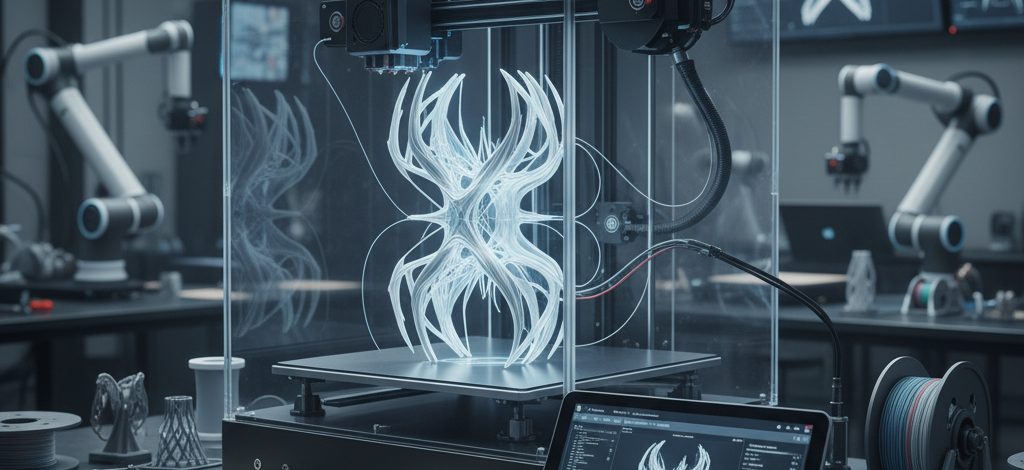
One of the most fascinating topics in this advanced course is Topology Optimization, a design technique that helps you create structures that are both lightweight and incredibly strong. Instead of manually shaping a model, you use powerful software tools that automatically remove unnecessary material while keeping the part durable and functional. The result is an organic, futuristic-looking design—similar to structures found in nature—that performs better than traditional shapes.
This topic stands out because it blends engineering intelligence with creative freedom. You’ll learn how to optimize parts for real-world applications such as aerospace components, mechanical parts, medical devices, and custom products. By understanding how to balance strength, weight, performance, and material use, you gain the ability to design smarter, more efficient products that take full advantage of the power of additive manufacturing.
Job Opportunities
Here are some interesting job opportunities after completing the Advanced Design and 3D Printing course:
Freelance 3D Designer (Advanced): Offer specialized design, simulation, and high-end 3D printing services for engineering firms, startups, and creative industries.
Research Associate in Additive Manufacturing: Contribute to advanced research projects involving new materials, printing methods, and design strategies.
Design Consultant for Additive Manufacturing: Provide expert design solutions to companies adopting 3D printing for production and innovation.
Materials & Process Engineer (3D Printing): Work with advanced printing materials, analyze performance, and improve additive manufacturing processes.
Industrial 3D Printing Technician: Operate and maintain professional-grade printers including resin, SLS, metal, and multi-material machines.
Topology Optimization Specialist: Use simulation-based tools to engineer lightweight, high-strength structures for cutting-edge applications.
Rapid Prototyping Specialist: Develop high-precision prototypes, validate designs, and support R&D teams in innovation labs or tech startups.
Frequently asked questions
How is this course different from a basic 3D printing course?
This course goes deeper into complex modeling, structural optimization, multi-material printing, and industry-level workflows that aren’t covered in basic training.
Will I learn to work with industrial materials like resins and composites?
Yes! You will explore how advanced materials behave, how to select them for specific applications, and how to print them effectively.
Do we get to work with simulation tools?
Definitely. You’ll use simulation software to test stress, strain, and performance—helping you refine your design before printing.
Is prior CAD experience necessary?
Basic familiarity with CAD tools is recommended, as this course focuses on advanced modeling and design strategies.
What kinds of advanced printers will I use?
Depending on the lab setup, you may get hands-on experience with resin (SLA/DLP), SLS, metal-like filaments, and multi-material printers.