
Embedded IoT Specialist Course
The Embedded IoT Specialist Course is designed to develop expertise in building intelligent, connected embedded systems. It covers microcontrollers, embedded programming, sensors and actuators, communication protocols, and cloud integration for IoT applications. Through hands-on labs and real-world projects, learners gain practical experience in developing secure, low-power, and scalable IoT devices. This course bridges embedded systems and IoT technologies, preparing participants for industry-relevant roles in smart devices, automation, and Industry 4.0 solutions.
- 144 Hours (2 hours/day x 6 days/week x 12 weeks) OR at your own pace
- Hindi, English
- Learn & Get Certified
- Basic & Intermediate
- Hands-On Training
- Kit cost of Rs. 6,500 extra (Fixed)
Online Course Fees
About this course
The Embedded IoT Specialist Course is a 144-hour advanced training program.
It is designed as an extension for learners who have already completed the 152-hour IoT Engineer Master Course, bringing the total program duration to 182 hours and enabling students to advance from general IoT development to professional-level embedded engineering.
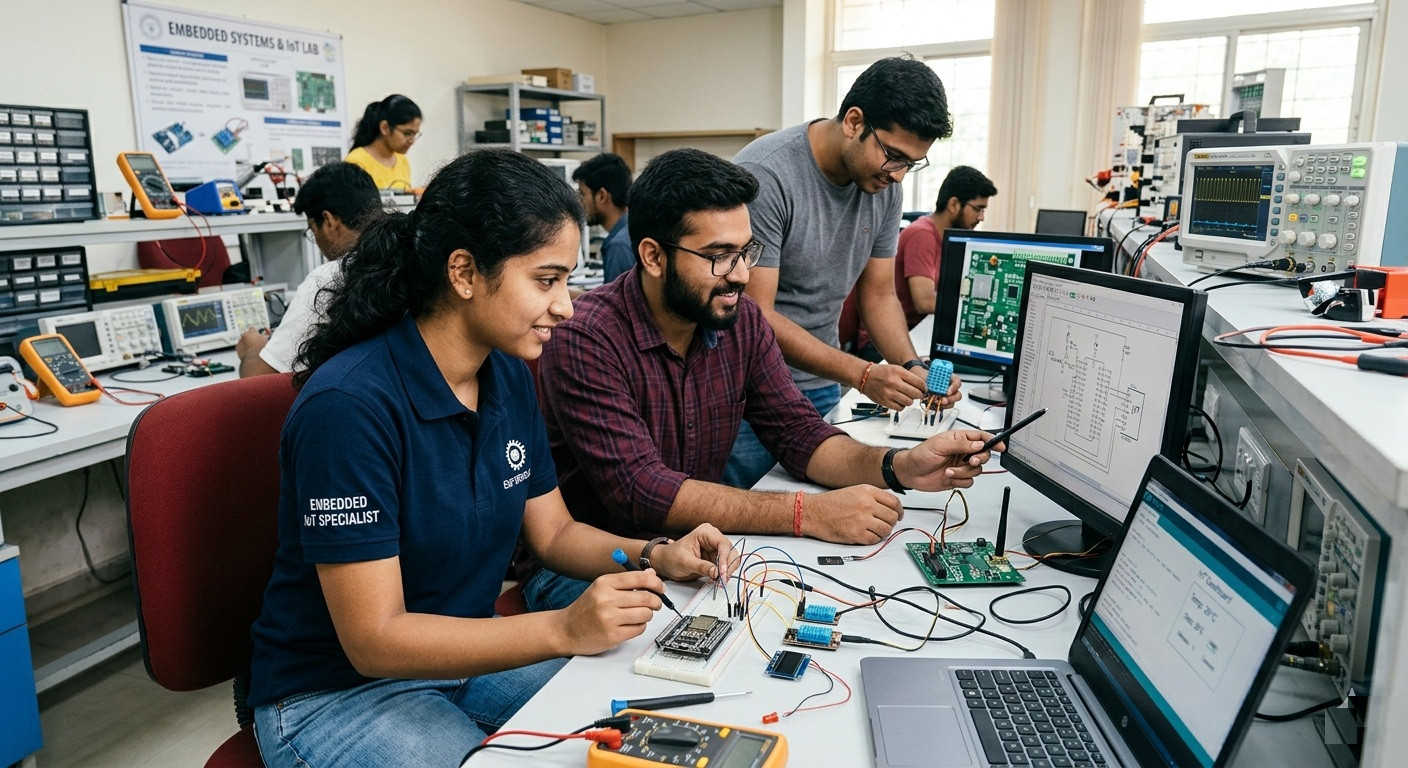
Through a blend of theory and hands-on practice, learners develop deeper skills in Embedded C programming, register-level control of GPIO, timers and ADCs, low-power optimization, RTOS fundamentals, PCB design using EasyEDA, and hardware debugging tools such as multimeters and logic analyzers. The training also covers sensor calibration, interface testing, and structured hardware validation workflows used in industry.
The course culminates in practical development exercises where learners design and build their own custom PCB-based IoT device or a low-power sensor node with deep-sleep functionality, integrating both firmware and hardware.
By the end of the program, participants are prepared to:
-contribute to embedded IoT product development,
-support hardware–firmware co-design, and
-work confidently on professional embedded systems engineering tasks.
This course provides essential knowledge and practical training to build industry-relevant skills.
- Online Course Fees: ₹
3,416, ₹2,372 (incl. GST) (Excluding tools & equipment cost) - Offline Course Fees: ₹
24,691, ₹21,948 (incl. GST) (Excluding tools & equipment cost) - Certification: TCoE
- Duration: 144 Hours (2 hours/day x 6 days/week x 12 weeks) OR at your own pace
What you'll learn
After this course you will learn:
- Embedded Systems Fundamentals – Understand microcontrollers, hardware architecture, memory management, and real-time processing concepts.
- Microcontroller Programming – Develop efficient, low-level firmware using C/C++ for platforms like ARM Cortex, STM32, AVR, and ESP32.
- Peripheral Interfacing – Work with GPIOs, ADC/DAC, timers, interrupts, UART, SPI, I²C, and other essential hardware interfaces.
- Sensor & Actuator Integration – Interface a wide range of sensors and actuators for real-time IoT data acquisition and control.
- RTOS (Real-Time Operating Systems) – Implement multitasking, scheduling, inter-task communication, and real-time constraints using FreeRTOS or similar platforms.
- Embedded IoT Connectivity – Learn Wi-Fi, BLE, LoRa, Zigbee, MQTT, and CoAP for efficient device-to-cloud communication.
- Edge Computing & Optimization – Apply techniques for low-latency analytics, power optimization, and efficient embedded data handling.
- PCB Design & Hardware Prototyping – Design custom PCBs, work with circuit schematics, and develop hardware prototypes for IoT devices.
Course Content
Why take this course?
This course is designed to build expertise at the intersection of embedded systems and Internet of Things technologies. You will learn to develop intelligent edge devices by integrating microcontrollers, sensors, communication protocols, and cloud platforms with efficient embedded software. The course emphasizes hands-on development of secure, low-power, and scalable IoT solutions used in smart manufacturing, healthcare, automotive, agriculture, and smart infrastructure. As industries increasingly adopt connected and autonomous systems, this course prepares you for specialized, high-demand roles in embedded IoT design, deployment, and innovation.
How to use online TCoE platform?
Tools and Equipment required
National Skill Development Mission
Module 1: Embedded IoT Foundations
- Embedded IoT: Definition and concept of embedded IoT, embedded devices and connected smart systems, elements of embedded IoT systems, role of sensors, actuators, controller, communication interface and power unit, applications of embedded IoT in smart home, healthcare, agriculture, industrial monitoring and smart city systems.
- Embedded System vs IoT System: Concept of embedded system and IoT system, comparison between standalone embedded systems and internet-connected systems, local control and remote monitoring, data logging and cloud interaction, transformation of an embedded system into an IoT-enabled system.
- Real-Time Connected Devices: Concept of real-time connected devices, need of timely sensing and response, soft and hard real-time applications in IoT, latency, response time and update rate, examples of connected real-time systems in healthcare, industrial automation, surveillance and safety applications.
- Device–Gateway–Cloud Model: Architecture of IoT systems, device layer, gateway layer and cloud layer, data acquisition, local processing, protocol conversion, data aggregation, storage, analytics and dashboarding, telemetry and command flow, direct-to-cloud and gateway-based IoT architectures.
- Product Lifecycle: Stages of embedded IoT product development, idea generation, requirement analysis, system design, hardware and software development, prototyping, testing, deployment, maintenance, firmware updates and end-of-life considerations.
- Design Constraints: Cost constraints, power constraints, memory constraints and reliability constraints in embedded IoT systems, trade-off between performance and cost, battery-powered and mains-powered operation, low-power design awareness, memory limitations, environmental effects, fault tolerance and reliability requirements.
Module 2: Electronics Essentials for IoT Devices (Basics of Electronics)
Basic Electrical Quantities: Voltage, current, resistance, power and energy, Ohm’s law, AC and DC supply, series and parallel circuits, Kirchhoff’s laws, open circuit, short circuit, polarity and continuity concepts.
Passive Components: Resistor, fixed and variable resistor, resistor wattage, capacitor, capacitor polarity, types of capacitors, basic applications of capacitors, inductor and basic applications of inductors, jumper wires and interconnections.
Semiconductor Components: Diode, diode characteristics, forward and reverse bias, diode symbol and terminal identification, LED, LED polarity identification, coloured LEDs, bridge rectifier concept, Zener diode and its basic applications.
Transistor and Switching Devices: Transistor as switch and amplifier, basic construction and operation of BJT and MOSFET, transistor terminal identification, NPN and PNP transistors, introductory MOSFET applications in embedded and IoT circuits.
Supporting Circuit Elements: Pull-up and pull-down resistors, voltage divider circuits, relays, regulators, fuse, connector types, terminal blocks, basic circuit symbols, reading of simple circuit diagrams, adapter supply and battery supply.
Power and Protection Basics: Linear and switching regulators, basic battery types, grounding concepts, noise and decoupling basics, ESD basics, reverse polarity protection, overcurrent and short-circuit protection, electrical safety considerations for embedded IoT hardware.
Measurement and Lab Tools: Multimeter, breadboard, DC power supply, soldering iron and accessories, wire stripping and crimping tools, desoldering tools, proper use of measuring instruments for circuit testing and troubleshooting.
Module 3: Embedded Programming Fundamentals
Introduction to Programming: Concept of programming, problem solving through programs, algorithms and flowcharts, steps involved in program development, basic structure of a program, logic building and structured programming.
Programming Elements: Variables, constants, keywords, data types and operators, expressions and statements, input and output concepts, type conversion and basic program execution flow.
Control Statements: Decision making using if, if–else and switch statements, iterative statements using for, while and do–while loops, nested control structures and their applications in embedded programming.
Data Handling: Arrays, strings and basic data manipulation, use of data structures for storing sensor values, status flags and control parameters in embedded applications.
Functions and Modularity: Concept of functions, function declaration and definition, parameter passing, return values, importance of modular programming and code reusability.
C Programming Basics: Introduction to C language, basic syntax, preprocessor directives, header files, macros, structures, unions, enums and typedef, scope and lifetime of variables, storage classes and recursion basics.
Embedded C Concepts: Difference between standard C and Embedded C, role of compiler, linker and hex file, memory-constrained programming, volatile keyword, pointers in embedded systems, bitwise operations, masking, shifting, setting and clearing of bits, direct register access, memory-mapped I/O, interrupt-oriented programming and finite state machine design.
Program Development and Debugging: Compilation process, reading and resolving syntax and logical errors, use of IDEs, debugging basics, serial output for debugging, writing simple embedded programs for device control and sensor interfacing.
Module 4: Microcontrollers, Development Environment and Embedded Interfaces
Microcontroller Fundamentals: Concept of microcontroller, microprocessor versus microcontroller, architecture basics, CPU, ALU, RAM, ROM, EEPROM and Flash memory, bus system, clock and oscillator, reset circuit, boot sequence, memory map, I/O ports, peripheral overview, interrupt system, timers/counters, watchdog timer and low-power modes.
Development Boards and Platforms: Overview of Arduino Uno/Nano, ESP32 and STM32 boards, development board versus production board, pin configuration and peripheral availability, selection of suitable controller platform for embedded IoT applications.
Development Environment: Embedded development workflow, source code, executable and hex file, role of compiler, assembler and linker, IDE concept, use of Arduino IDE, board selection, port selection, sketch creation, compilation, uploading and execution of program, use of serial monitor, library management and debugging errors.
Alternative Embedded Toolchains: Introduction to VS Code with PlatformIO, ESP-IDF basics and Proteus for simulation, role of development tools in embedded firmware design, testing and deployment.
Digital Interfacing: GPIO concepts, digital input and digital output, sourcing and sinking current, pull-up and pull-down techniques, switch interfacing, relay driver circuits, optocoupler basics and digital control applications.
Timers, Interrupts and PWM: Timer basics, delay versus timer-based design, polling versus interrupt, external interrupt concept, PWM generation, duty cycle, frequency and resolution, servo control basics and motor speed control basics.
Analog and Sensor Interfacing: Analog versus digital signals, ADC basics, resolution, reference voltage, conversion time, signal conditioning basics, filtering, calibration, threshold and event detection, smoothing techniques and sampling rate selection for sensor data acquisition.
Display and Human Interface: Character LCD, OLED, TFT basics, matrix keypad, rotary encoder, basic display interfacing and user interaction concepts in embedded systems.
Serial Communication Interfaces: Communication fundamentals, synchronous and asynchronous communication, UART, SPI and I2C protocols, baud rate, framing, addressing, acknowledgement, protocol comparison, serial debugging and level shifting basics.
Embedded Debugging: Hardware and firmware debugging methodology, divide-and-test approach, use of multimeter, oscilloscope and serial output for debugging, common wiring mistakes, power supply issues, grounding and noise issues, startup problems, connectivity diagnosis and root-cause analysis.
Module 5: IoT Communication, Networking and Cloud Integration
IoT Fundamentals: Concept of Internet of Things, architecture of IoT systems, edge, gateway and cloud, local server and cloud server, telemetry and command flow, IoT device lifecycle and case studies of connected embedded systems.
Wireless Connectivity: Wi-Fi, Bluetooth Classic, BLE, GSM/GPRS, GPS, LoRa and Zigbee basics, RF overview, antenna awareness, signal strength and placement, range, interference and power implications of wireless communication in IoT devices.
Networking Basics: Local Area Network, Wide Area Network, router, switch and IP address, device addressing in connected systems, basic network communication requirements for IoT deployment.
Application Layer Communication: MQTT protocol, MQTT publish–subscribe model, HTTP/REST basics, local and cloud dashboards, mobile app interaction, telemetry, command exchange and event-based communication in IoT systems.
IoT Platforms: ESP8266/ESP32 as IoT platforms, Arduino IoT Cloud, Blynk, ThingsBoard, Node-RED and Firebase overview, use of dashboards, alerts, visualization and remote device interaction.
Protocol Integration: UART, SPI and I2C in IoT nodes, MQTT over serial gateway concept, Modbus basics, RS232/RS485 basics, BLE basics and communication between sensor node, gateway and cloud.
Provisioning and Connectivity Management: Wi-Fi provisioning basics, network troubleshooting basics, connectivity failure diagnosis, device onboarding, local versus remote configuration and basic device authentication concepts.
Cloud and Data Flow: Data transmission from device to cloud, cloud-to-device commands, local storage versus cloud storage, timestamped logging, buffering, offline data sync and retry logic, telemetry flow, dashboard update flow and alert rule basics.
Security in IoT Communication: Security basics in IoT, cloud credential safety, API key and token handling basics, privacy basics, secure provisioning awareness, secure communication concepts and safe use of connected devices in field environments.
Cloud-Ready Debugging and Deployment: Sensor-to-cloud troubleshooting, protocol debugging, telemetry validation, dashboard verification, command testing and practical issues in real IoT deployment.
Module 6: Data Logging, Analytics, Security and Deployment for Embedded IoT Systems
Data Logging and Storage: Concepts of data logging in embedded IoT systems, use of RAM, ROM, EEPROM, Flash memory and SD card interface, volatile and non-volatile storage, data buffering, configuration storage, timestamped logging, local data retention, local versus cloud storage and offline data synchronization with retry logic.
IoT Data Handling and Analytics Basics: Nature of IoT data, structured and time-series data, sensor sampling rate selection, data smoothing, threshold and event detection, missing data awareness, local preprocessing, cloud-side analytics overview, dashboard visualization, data trends, alert generation and basic interpretation of IoT data for monitoring and decision making.
Power Management for IoT Nodes: SMPS basics, battery types, charging basics, BMS basics, buck converter, boost converter, LDO, reverse polarity protection, overvoltage and overcurrent protection, grounding, isolation, power budgeting, battery-powered embedded design, power consumption estimation, battery backup calculation and sleep current measurement in IoT devices.
Reliability, Testing and Validation: Unit testing basics, hardware testing, integration testing, regression thinking, EMI/EMC awareness, ESD precautions, quality checklist, validation versus verification, acceptance testing, field testing considerations and reliability issues in connected embedded products.
IoT Security Fundamentals: Security basics in IoT, secure boot awareness, firmware update methods, OTA updates, OTA failure recovery, secure firmware update basics, secure provisioning and certificate basics, cloud credential safety, API key and token handling, device authentication basics, privacy considerations and secure communication awareness for connected systems.
Debugging and Fault Diagnosis in Deployed Systems: IoT device debugging workflow, connectivity failure diagnosis, sensor-to-cloud troubleshooting, firmware fault tracing, telemetry verification, dashboard validation, root-cause analysis and fault reporting in field-deployed systems.
Product Engineering and Deployment: Requirement analysis, conversion of user need into technical specification, block diagram design, hardware-software partitioning, component selection, BOM preparation, prototype planning, design reviews, test plan preparation, field deployment considerations, documentation and maintenance practices for embedded IoT products.
Professional Practices and Career Readiness: Datasheet reading, documentation importance, project reporting, teamwork and communication, project demonstration skills, technical presentation, revision control and practical readiness for industry-oriented embedded IoT roles.
Module 7: Sensor and Actuator Integration for Embedded IoT Systems
Sensor Fundamentals: Classification of sensors, analog and digital sensors, active and passive sensors, signal generation and sensing principles, role of sensors in embedded IoT applications.
Common IoT Sensors: LDR, potentiometer, NTC thermistor, LM35/TMP sensors, DHT11/DHT22, ultrasonic sensor, PIR sensor, IR sensor, gas sensor, soil moisture sensor and pressure sensor basics, operating principles and application areas.
Sensor Interfacing: Interfacing of analog and digital sensors with microcontrollers, use of ADC for analog sensing, signal conditioning, calibration, noise reduction, sampling and conversion considerations.
Actuator Fundamentals: Concept of actuators, electrical and electromechanical actuators, role of actuators in control systems, relationship between sensing and actuation in closed-loop IoT systems.
Common Actuation Elements: Relays, buzzers, LEDs, solenoids, servo motors, DC motors and basic output control devices used in embedded IoT products.
Sensor-Based Control: Threshold-based control, event-driven control, automation using sensor inputs, local decision making and actuator triggering in practical IoT systems.
Practical Integration Considerations: Connector selection, signal compatibility, power requirements, protection circuits, sensor placement, actuator isolation and reliability in real applications.
Module 8: Motor Control and Motion Interface for IoT Applications
Motor Fundamentals: Basic concepts of electrical motion systems, DC motors, servo motors and actuators, speed and torque relationship, use of motors in embedded and IoT-enabled automation products.
Motor Driver Circuits: Need for driver circuits, relay-based control, H-bridge, MOSFET-based switching, current requirements, flyback protection and safe switching of inductive loads.
PWM-Based Control: Pulse Width Modulation for motor speed control, duty cycle, frequency and resolution, relation of PWM with actuator response and control accuracy.
Servo and Motion Control: Servo control basics, position control, motion control logic and use of actuators in embedded mechanisms and automated systems.
Practical Motion Interface: Integration of motor drivers with microcontrollers, supply isolation, load considerations, safety precautions and embedded control of small automation systems.
Applications: Smart gate control, fan speed control, curtain control, small industrial automation units and sensor-triggered motion systems.
Module 9: Real-Time Operating Systems for Embedded IoT
Real-Time Systems: Definition of real-time systems, hard real-time and soft real-time concepts, role of timing in connected embedded products.
RTOS Fundamentals: Task, scheduler, priority, task states, context switching, software timers and role of RTOS in multitasking embedded systems.
Synchronization and Communication: Semaphores, mutex, queues, event groups, inter-task communication, task synchronization, deadlock basics and priority inversion.
FreeRTOS Concepts: Introduction to FreeRTOS, organization of tasks, scheduling strategies, timer services and resource sharing in RTOS-based embedded firmware.
ESP32 FreeRTOS Usage: Use of RTOS with ESP32, task creation, communication between tasks, sensor task and communication task management, timing considerations in IoT applications.
RTOS-Safe Firmware Design: RTOS-safe coding basics, modular task design, thread-safe access, timing predictability and reliable firmware architecture for connected devices.
Applications: Multitasking sensor nodes, real-time telemetry systems, event-driven IoT devices and data acquisition units with concurrent tasks.
Module 10: Advanced IoT Connectivity and Wireless Systems
Communication Architecture: Communication requirements in IoT systems, node-to-node, node-to-gateway and node-to-cloud communication, protocol selection based on range, speed, power and reliability.
Wireless Technologies: Wi-Fi, Bluetooth Classic, BLE, GSM/GPRS, GPS, LoRa and Zigbee, comparative features, range, bandwidth, power consumption and suitable use cases.
Short-Range and Long-Range Connectivity: Short-range wireless communication for local automation systems and long-range wireless systems for remote sensing and monitoring applications.
Provisioning and Network Setup: Wi-Fi provisioning, network joining methods, signal strength, antenna placement, interference considerations and wireless deployment issues in field conditions.
Protocol-Level Connectivity: MQTT, telemetry, command packets, gateway-based communication, serial-to-cloud data transport, MQTT over serial gateway concept and edge communication integration.
Troubleshooting Wireless Systems: Connectivity failure diagnosis, packet loss awareness, unstable links, power-related communication failures and field-level wireless debugging practices.
Applications: Home automation, smart agriculture, industrial remote sensing, location-aware devices, mobile-controlled embedded nodes and long-range telemetry systems.
Module 11: IoT Cloud Platforms, Dashboards and Data Services
Cloud Fundamentals: Role of cloud in embedded IoT systems, remote data storage, monitoring, control, analytics and alert generation.
IoT Platforms: Arduino IoT Cloud, Blynk, ThingsBoard, Node-RED and Firebase basics, platform architecture and role in device connectivity and visualization.
Dashboard Design: Local and cloud dashboard concepts, real-time data display, key performance indicators, event display, user interaction and dashboard usability.
Data Visualization: Visualization of sensor data using tables, charts and live dashboards, trend observation, threshold-based alerts and presentation of operational information.
Device–Cloud Interaction: Telemetry upload, cloud-to-device command flow, remote parameter update, event handling and user-side control interface.
Alerting and Notification: Alert design basics, event rules, threshold violations, automation triggers and practical use of remote notifications in IoT applications.
Authentication and Cloud Access: Device authentication basics, account-based access, dashboard user control, data permissions and secure platform usage awareness.
Applications: Smart monitoring systems, remote control dashboards, environmental monitoring panels, asset monitoring platforms and field device management interfaces.
Module 12: Storage, Logging and Data Management in IoT Systems
Memory Elements: RAM, ROM, EEPROM, Flash and SD card interface, role of volatile and non-volatile memory in embedded IoT systems.
Data Logging Concepts: Storage of sensor data, event logs, status logs and historical records, need of persistent logging in industrial and field-deployed devices.
Configuration Storage: Storage of configuration parameters, calibration values, thresholds and user settings in non-volatile memory.
Buffering and Temporary Storage: Data buffering basics, queueing of measurements before transmission, local storage before upload and use of buffers in communication reliability.
Time-Stamped Logging: Timestamped logging basics, sequence of data entries, relation of time information with monitoring and analytics.
Local vs Cloud Storage: Comparison of local and cloud storage, design choices for remote and offline systems, hybrid storage strategy for reliability and traceability.
Offline Sync and Retry Logic: Temporary local logging during communication loss, store-and-forward concept, retry mechanisms and synchronization after reconnection.
Data Retention and Management: Local retention policy, storage limits, efficient memory use, logging frequency and practical data handling considerations.
Module 13: Reliability, Protection and Power Management in Embedded IoT
Power System Fundamentals: SMPS basics, battery types, charging basics, BMS concepts, battery-powered embedded design and supply architecture for IoT nodes.
Regulation and Conversion: Buck converter, boost converter, LDO, power rail requirements, voltage stability and regulator selection for embedded devices.
Protection Concepts: Reverse polarity protection, overvoltage and overcurrent protection, short-circuit protection, fuse concepts and protective design awareness.
Grounding and Isolation: Grounding basics, isolation concepts, safe supply design, protection from noise and stable field operation.
Low-Power Design: Sleep modes, low-power operation, power budgeting, current estimation, battery backup calculation and sleep current measurement for IoT nodes.
Noise and Decoupling: Electrical noise, decoupling basics, stable sensor operation, communication reliability and impact of poor power integrity on device performance.
Reliability Considerations: Temperature, EMI/EMC awareness, ESD precautions, long-term operation, environmental effects, robustness of field devices and dependable product behavior.
Applications: Battery-powered sensor nodes, portable connected devices, remote monitoring units and energy-aware IoT deployments.
Module 14: Testing, Validation and Debugging of Embedded IoT Products
Testing Fundamentals: Unit testing, hardware testing, integration testing, regression thinking and validation versus verification in embedded IoT products.
Hardware Debugging: Board inspection, continuity testing, voltage measurement, power rail checks, hardware bring-up and use of multimeter and oscilloscope.
Firmware Debugging: Serial debugging, error tracing, event monitoring, timing issues, sensor anomalies and firmware fault isolation.
Protocol and Connectivity Debugging: Communication protocol debugging, wireless diagnostics, MQTT/debug flow, connectivity failure diagnosis and sensor-to-cloud troubleshooting.
Field Fault Diagnosis: Startup issues, brownout issues, intermittent faults, noise-related failures, unstable communication and real-world error cases.
Checklist and Root Cause Analysis: Debugging checklist, divide-and-test approach, observation methods, root cause analysis and structured troubleshooting process.
Acceptance and Field Validation: Acceptance testing, reliability observation, pre-deployment checks and validation of embedded IoT systems before release.
Module 15: Secure Embedded IoT Systems
IoT Security Fundamentals: Security basics in IoT, importance of secure connected products, threats in remote and cloud-connected embedded systems.
Firmware and Update Security: Bootloader basics, firmware upgrade methods, OTA updates, OTA failure recovery, secure firmware update basics and update management in deployed devices.
Provisioning and Authentication: Device provisioning basics, secure provisioning awareness, authentication basics and secure onboarding of connected devices.
Credential and Access Security: Cloud credential safety, API key and token handling, safe storage of sensitive access data and secure use of connected platforms.
Secure Communication Awareness: Privacy basics, secure communication considerations, trusted data flow and security-minded design of IoT communication paths.
Product Security Practices: Documentation, configuration protection, operational discipline and lifecycle-based security awareness in embedded IoT products.
Module 16: Product Design, Deployment and Documentation
Requirement Engineering: Requirement analysis, user need to technical specification, problem definition and translation of functional need into engineering design.
System Design: Block diagram design, hardware-software partitioning, component selection, architecture planning and module integration in embedded IoT products.
Prototype Development: BOM preparation, prototype planning, early-stage design reviews and iterative hardware-software integration.
Design for Deployment: Test plan preparation, field deployment considerations, maintainability and practical deployment workflow for real connected products.
Documentation Practices: Documentation importance, design notes, maintenance records, revision control, technical records and product support documentation.
User and Service Documentation: User manual writing, service manual basics, technical instructions and support-oriented documentation for fielded products.
Professional Product Workflow: Review of lifecycle from idea to deployment, reporting practices, project documentation and engineering communication.
Module 17: Industry Applications and Case Studies of Embedded IoT
Application Domains: Embedded IoT applications in automotive, medical systems, industrial automation, drone systems and smart consumer products.
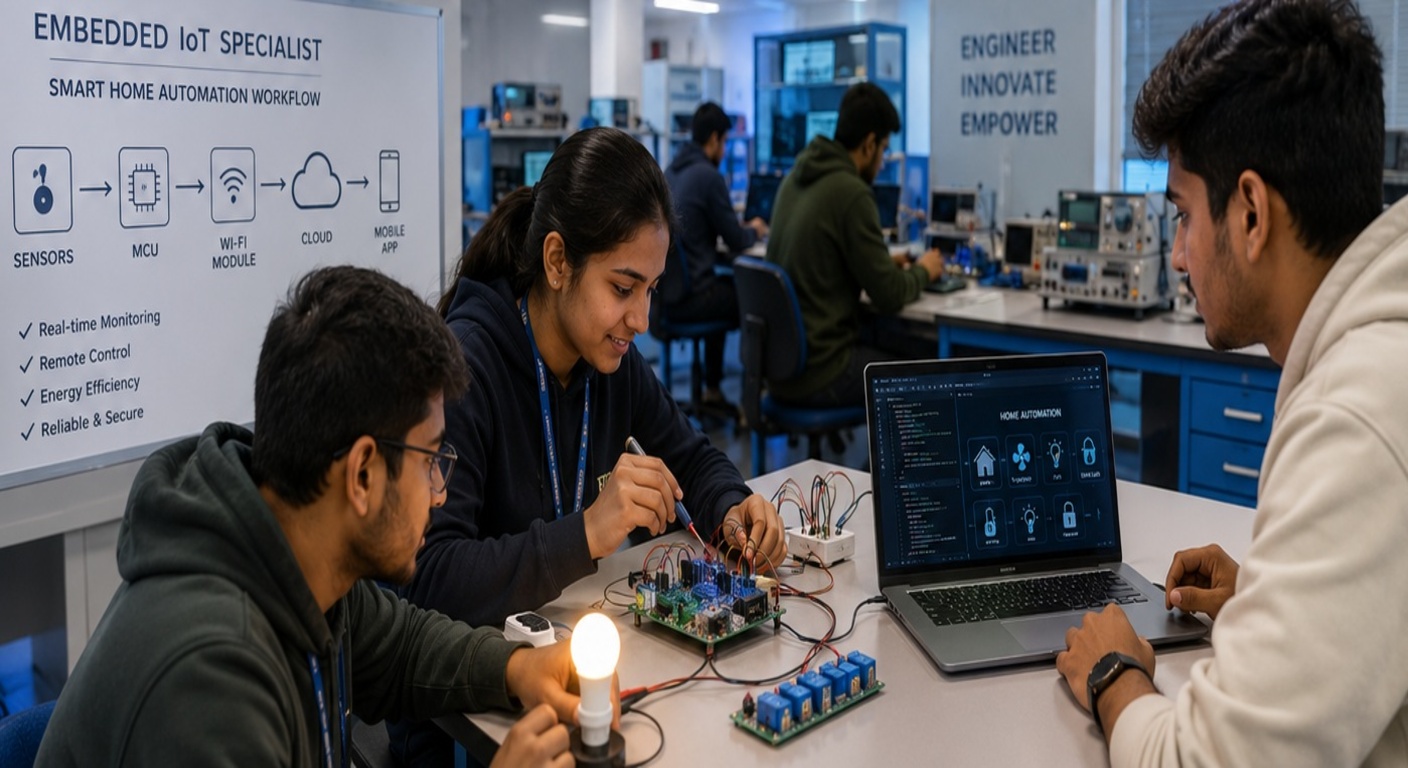
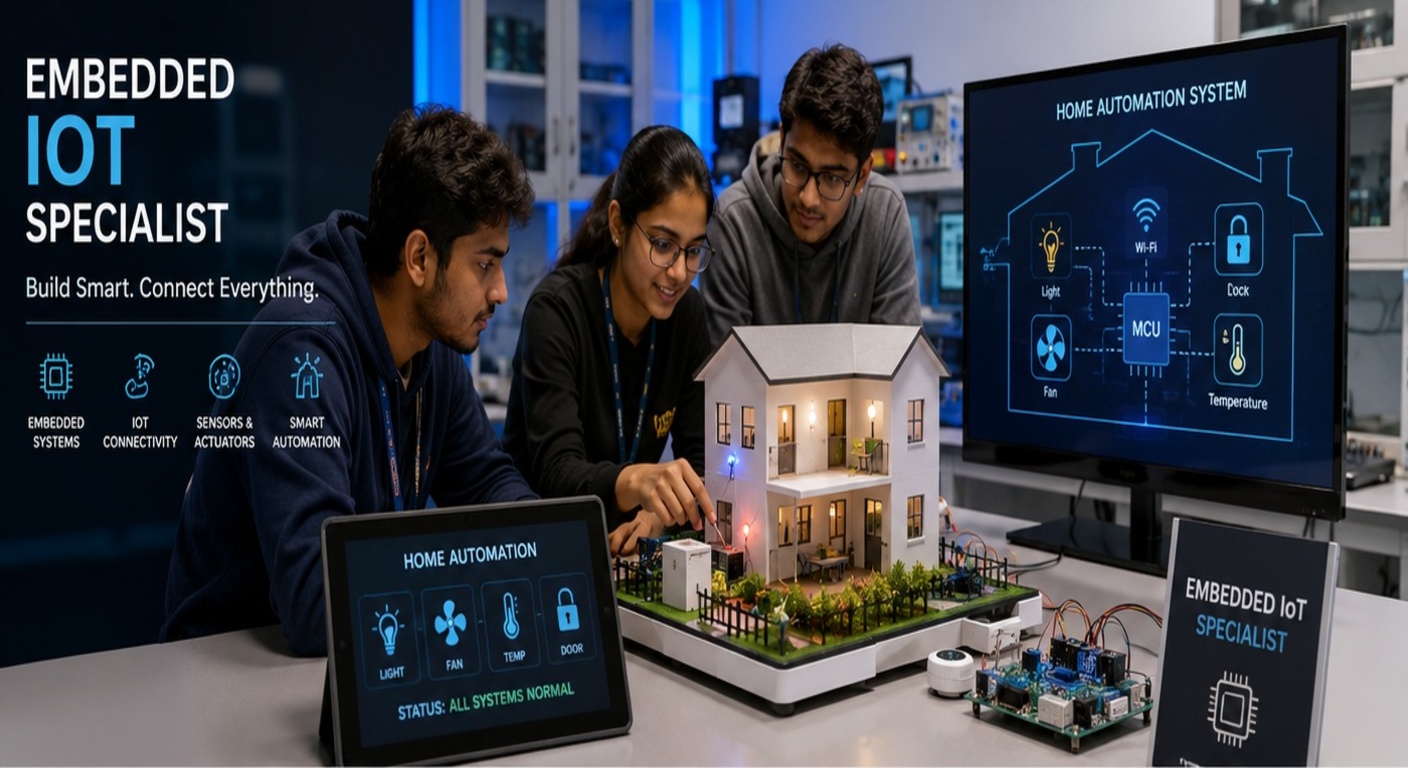
Connected Product Case Studies: Smart home automation, remote monitoring systems, industrial IoT nodes, smart agriculture, utility metering and healthcare monitoring devices.
Industrial Integration Concepts: Sensor networks, telemetry systems, field deployment, data logging, cloud dashboards and reliability expectations in industry-oriented products.
Comparative Understanding: Domain-wise constraints such as safety, connectivity, reliability, energy use, update strategy and monitoring requirements.
Problem-Solving Orientation: Selection of architecture, sensors, communication method and deployment strategy based on application-specific requirements.
Module 18: Professional Practice, Portfolio and Career Readiness
Engineering Communication: Communication skills for engineers, teamwork, technical reporting and project presentation in embedded IoT environments.
Project Demonstration Skills: Demonstration planning, explanation of architecture, hardware-software workflow, dashboard presentation and user-oriented technical communication.
Documentation and Reporting: Client/project reporting, structured documentation, technical note preparation and organized maintenance of project files.
Portfolio Development: Project record creation, structured presentation of prototypes, code organization, GitHub portfolio awareness and documentation-based employability improvement.
Interview and Industry Readiness: Technical discussion readiness, debugging-oriented thinking, viva preparation, datasheet-based understanding and practical confidence for industry roles.
ENROLL TODAY & GET 30% OFF ON ALL COURSES
Your Future Can’t Wait, Enroll Now and Save 30% On All Courses.
Related Courses

Fundamentals of AIoT

Fundamental of Robotronics

Robotics

IoT-Based Automation System
what our students say
With over a decade of experience, our mission is to produce future-ready skilled resources.




Real-Time Embedded Systems Development
This area of the course focuses on designing and programming systems that respond instantly to real-world events — like automotive control units, medical devices, and IoT gadgets. Learners explore real-time operating systems (RTOS), interrupt handling, task scheduling, and low-level hardware interfacing, gaining hands-on experience in building efficient, reliable, and time-critical embedded applications.
Job Opportunities
Here are some interesting job opportunities after completing the Embedded Software Engineer course:
Embedded Systems Developer – Design and program software that runs directly on microcontrollers and embedded devices.
Firmware Engineer – Develop and optimize low-level code for devices such as wearables, smart appliances, and automotive systems.
IoT Solutions Engineer – Build and integrate connected smart devices for home automation, healthcare, and industrial IoT applications.
Automotive Embedded Engineer – Work on advanced vehicle systems like engine control units (ECUs), ADAS, and infotainment systems.
Robotics Programmer – Develop embedded control systems for robots, drones, and automated machinery.
Embedded Test Engineer – Design testing procedures and debugging tools to ensure system reliability and safety.
Embedded AI Engineer – Implement lightweight AI models on edge devices for intelligent data processing and automation.
Frequently asked questions
What are embedded systems, and why are they important to learn about?
Embedded systems are like the brains of devices. Learning about them is important because they’re everywhere, offer job opportunities, make things work efficiently, drive innovation, and teach problem-solving skills.
How can online courses help you learn about embedded systems?
Online courses are helpful for learning embedded systems because they offer flexibility, hands-on experience, and up-to-date content.
What skills or experience do I need to already have, before starting to learn embedded systems?
Before learning embedded systems, it’s helpful to have basic programming, electronics, math, and problem-solving skills, but you can start as a beginner too.
What kind of people are best suited for work that involves embedded systems?
People best suited for embedded systems work are analytical, detail-oriented, curious, persistent, and tech enthusiasts who can work in teams and adapt to change.
Is the training course available online or in-person?
Both modes are offered depending on the learner’s flexibility. May contct us directly to discuss more details.