Terrain Mapping Drone Engineer Course
The Terrain Mapping Drone Engineer Course is designed to develop skills in using drones for accurate land surveying and geospatial mapping. It covers mapping drone platforms, flight planning, photogrammetry basics, data acquisition, and processing to generate maps, contours, and 3D terrain models. Through hands-on exercises and real-world projects, learners gain practical experience in delivering precise and efficient mapping solutions. This course prepares participants for technical roles in surveying, infrastructure development, mining, urban planning, and environmental monitoring using drone technology.
- 72 hours (2 hours/day x 6 days/week x 6 weeks) OR at your own pace
- Hindi, English
- Learn & Get Certified
- Basic & Intermediate
- Hands-On Training
Online Course Fees
Offline Course Fees
About this course
Terrain Mapping Drone Course focuses on the application of drones for surveying and mapping land features with high precision. The course covers drone hardware, GPS systems, sensors, photogrammetry, and data processing techniques to generate maps, 3D models, and elevation profiles. Students will gain practical knowledge of drone operations and mapping workflows used in agriculture, construction, mining, and environmental studies.
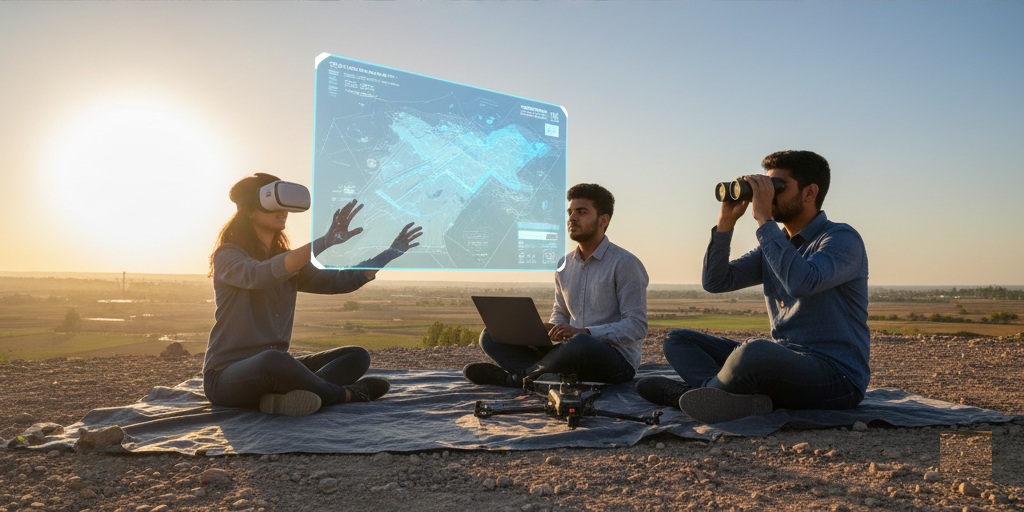
Participants will gain practical skills in drone flight planning, aerial data collection, and processing techniques for generating accurate 2D maps and 3D terrain models.
This course provides essential knowledge and practical training to build industry-relevant skills.
- Online Course Fees: ₹3500, ₹2500 (incl. GST) (Excluding tools & equipment cost)
- Offline Course Fees: ₹13500, ₹12000 (incl. GST) (Excluding tools & equipment cost)
- Certification: TCoE
- Duration: 72 hours (2 hours/day x 6 days/week x 6 weeks) OR at your own pace
What you'll learn
After this course you will learn:
- Drone Fundamentals for Mapping – Understand types of drones, payloads, and sensors suitable for high-precision terrain mapping.
- Photogrammetry & Remote Sensing – Learn aerial imaging, multispectral/LiDAR sensor integration, and capturing geospatial data for mapping.
- Flight Planning & Mission Design – Master waypoints, altitude, overlap, ground sampling distance (GSD), and autonomous mission programming for accurate surveys.
- Geospatial Data Acquisition – Capture high-resolution images and point clouds for topography, contour mapping, and 3D terrain modeling.
- Data Processing & GIS Integration – Use software tools to generate orthomosaics, digital elevation models (DEMs), and integrate with GIS platforms like ArcGIS/QGIS.
- Surveying & Land Analysis – Apply drone data for cadastral mapping, infrastructure planning, slope analysis, and land use assessment.
- Drone Maintenance & Sensor Calibration – Ensure precise mapping through regular calibration of cameras, LiDAR, GPS, and IMU sensors.
- Regulatory Compliance & Safety – Operate drones in compliance with DGCA (India) or local aviation rules, airspace regulations, and safety protocols.
Course Content
How to use online TCoE platform?
This course equips you with specialized skills to use drones for accurate terrain mapping and geospatial analysis. You will learn flight planning for mapping missions, operation of mapping-grade sensors, photogrammetry basics, data processing, and generation of high-precision maps and 3D models. With growing demand for drone-based surveying in infrastructure development, mining, urban planning, disaster management, and environmental monitoring, this course prepares you for high-value technical roles. It enables you to deliver faster, safer, and more cost-effective mapping solutions using advanced drone technology.
Advantages of this course
Tools and Equipment required
National Skill Development Mission
Module-1: Introduction to Terrain Mapping and Drone Basics
- This module provides an overview of terrain mapping concepts and the fundamental principles of drone technology.
- Learners will explore the basics of drone components, flight mechanisms, and operational guidelines, along with the role of drones in collecting and analyzing terrain data.
- The module sets the foundation for understanding how drones are applied in mapping, surveying, and geospatial studies.
Module-2: Advanced Techniques in Terrain Mapping
- This module focuses on advanced methods and technologies used in terrain mapping to achieve higher accuracy and detail.
- Learners will explore concepts such as LiDAR, photogrammetry, 3D modeling, and GIS integration, along with data processing techniques for creating precise terrain maps.
- The module emphasizes practical applications in surveying, environmental monitoring, and infrastructure planning.
Module-3: Applications and Project Development
- This module highlights real-world applications of terrain mapping and guides learners through the process of project development.
- Participants will explore case studies in agriculture, urban planning, disaster management, and environmental monitoring, while also learning how to design, plan, and execute drone-based mapping projects.
- The module equips learners with practical skills to apply terrain mapping techniques in diverse professional fields.
ENROLL TODAY & GET 30% OFF ON ALL COURSES
Your Future Can’t Wait, Enroll Now and Save 30% On All Courses.
Related Courses
Agricultural Drone Engineer

Junior Engineer Drone (R & D)

UAV Regulatory Affairs Consultant

Drone Engineer
See what our students have to say
With over a decade of experience, our mission is to produce future-ready skilled resources.
Photogrammetry and 3D Terrain Modeling
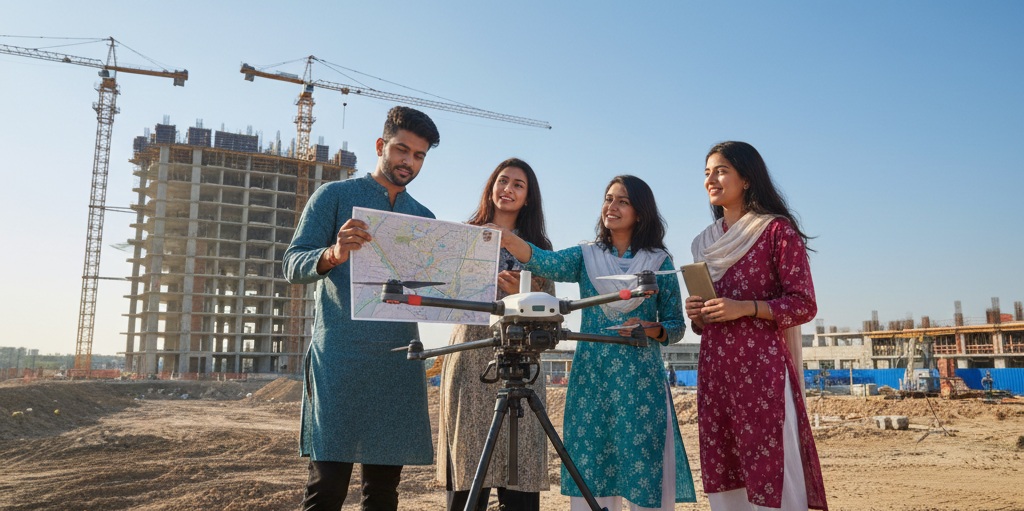
Photogrammetry is one of the most exciting and crucial topics in the Terrain Mapping Drone course. It involves capturing multiple overlapping aerial images using drones and processing them through specialized software to create detailed 2D maps and 3D terrain models. Learners explore how to convert raw drone imagery into orthomosaics, digital elevation models (DEM), and 3D point clouds that accurately represent the landscape. This topic also covers camera calibration, ground control points (GCPs), and accuracy assessment — essential skills for real-world mapping projects in construction, land surveying, and environmental analysis.
Job Opportunities
Here are some interesting job opportunities after completing the Terrain Mapping Drone course:
Aerial Survey Specialist – Conduct drone-based surveys for construction, mining, and land development projects, ensuring accurate topographical data collection.
GIS & Mapping Technician – Process aerial images and convert them into geospatial maps and 3D terrain models for government and private sector projects.
Remote Sensing Analyst – Analyze terrain data using drone imagery for applications in agriculture, forestry, and environmental monitoring.
Drone Operations Engineer – Manage and operate advanced mapping drones, ensuring efficient data capture and compliance with aviation regulations.
LiDAR Data Processing Expert – Work with LiDAR-equipped drones to create high-precision digital elevation and surface models used in engineering and surveying.
Construction Site Surveyor – Use drones to monitor site progress, measure stockpiles, and generate contour maps for project planning and management.
Environmental & Forestry Surveyor – Utilize drone mapping for vegetation analysis, terrain assessment, and ecological impact studies.
Frequently asked questions
What is the main goal of the Terrain Mapping Drone course?
The course aims to teach learners how to use drones for collecting, processing, and analyzing terrain data to create detailed 2D and 3D maps for various applications.
Do I need prior drone flying experience to join this course?
No prior experience is required! The course starts with drone fundamentals and gradually introduces mapping techniques, making it suitable for beginners.
What kind of drones are used for terrain mapping?
You’ll learn about both multirotor and fixed-wing drones equipped with high-resolution cameras, LiDAR sensors, and GPS modules for accurate data capture.
Will I learn to use mapping software in this course?
Yes! You’ll gain hands-on experience with popular photogrammetry and GIS software to process aerial images and create digital elevation models.
How is this course useful for my career?
It opens opportunities in surveying, GIS analysis, construction monitoring, urban planning, agriculture, and environmental conservation.